
Next up we headed to the Ballybunion Golf Links. I hadn’t been here since the spring of 1990 and remember nothing about the course other than the cemetery off the first tee. My son was 11 years old. It was pouring rain and the wind was howling and what made it even worse was the fog that made it almost impossible to see more than 100 yards ahead of you. This day would be different in that there would be only an occasional “spit” of rain so no rain gloves today; however, today the wind would howl all day blowing 30-40 mph.continuously. I decided to enjoy myself and not take on the “carries” over all the mounds, high grass, and assorted junk separating the tees from the fairway. I will admit to playing only a little more than 5,600 yards today, which enabled me to make all the carries and score decently–I think the slope rating would be a paltry 118, but the wind made it a lot tougher than that. I managed to accomplish two very similar strokes on the first tee in 1990 and 2026 by knocking my tee shot into the cemetery. This is the only “mulligan” I would take on this trip as I was really annoyed that I managed to hit the same tee shot in the cemetery as I managed to do the same thing in 1990. It was the first tee shot I hit to the right in the entire trip.
The Old Course at Ballybunion sits on some of the finest linksland in Ireland, a terrain of dunes and mounds along the Atlantic that gives you elevated tees, blind approaches, and greens that seem to have been descended into the landscape rather than built on it. On a still day it is hard enough — narrow, fast, unforgiving of anything hit sideways. In wind, like most Irish venues, distances mean little but club selection is critical. It is important to maneuver through the twists and turns of the fairways and avoid the mounding that will present very difficult lies. Placing the ball on the greens with wedges and the like is a matter of judgment allowing the window to work in your favor to either stop the ball or carry the ball to the front of the green where the putting presents potential scoring opportunities.
The 1st hole is a modest par four on the scorecard, but it plays alongside the old village cemetery, tombstones lining the right side of the fairway close enough to read the tombstones, and you are advised to honor the dead by not trying to locate where your errant tee shot landed on someone’s eternal resting place. It’s an unusual, faintly unsettling way to start a round, and it’s become one of the most talked-about opening holes in golf for exactly that reason.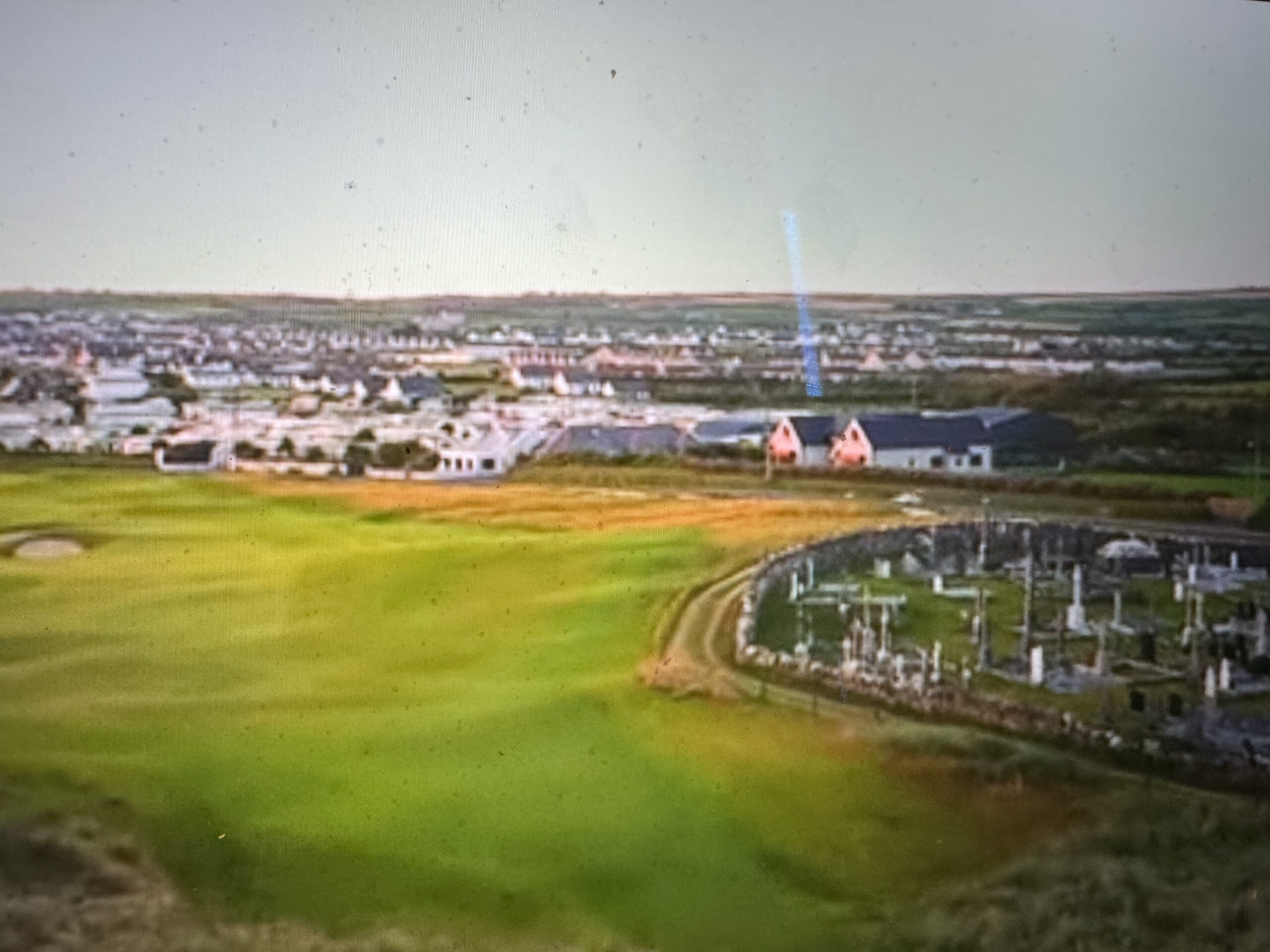
I enjoyed the flow of the following holes, which were pretty straightforward as you meander through the municipal roads and homes on the right of the course. The 6th doglegs along high ground with the Atlantic in full view, an early look at the cliffside drama the back nine is famous for. The 7th is often ranked among the best holes in Ireland — a par four bending along the edge of the dunes with the sea hard against the right side the whole way, demanding an accurate tee shot. The 8th, a long par three played across a valley to a green perched above the beach, punishes anything struck without full commitment, and in the wind I had, it was the hole where club selection mattered more than anywhere else on the course.
The 11th is the hole most golfers leave talking about. It runs along the cliff top with nothing but rough and a long drop to the strand on the right, and it’s the hole Tom Watson has singled out for praise more than any other at Ballybunion — a hole he’s called one of the finest he’s ever played. In a crosswind off the water, standing on that tee is as tough a test as links golf offers: play safe left and focus on fighting the second shot, or challenge the edge and accept what the wind does to a ball that may drift uncontrollably.
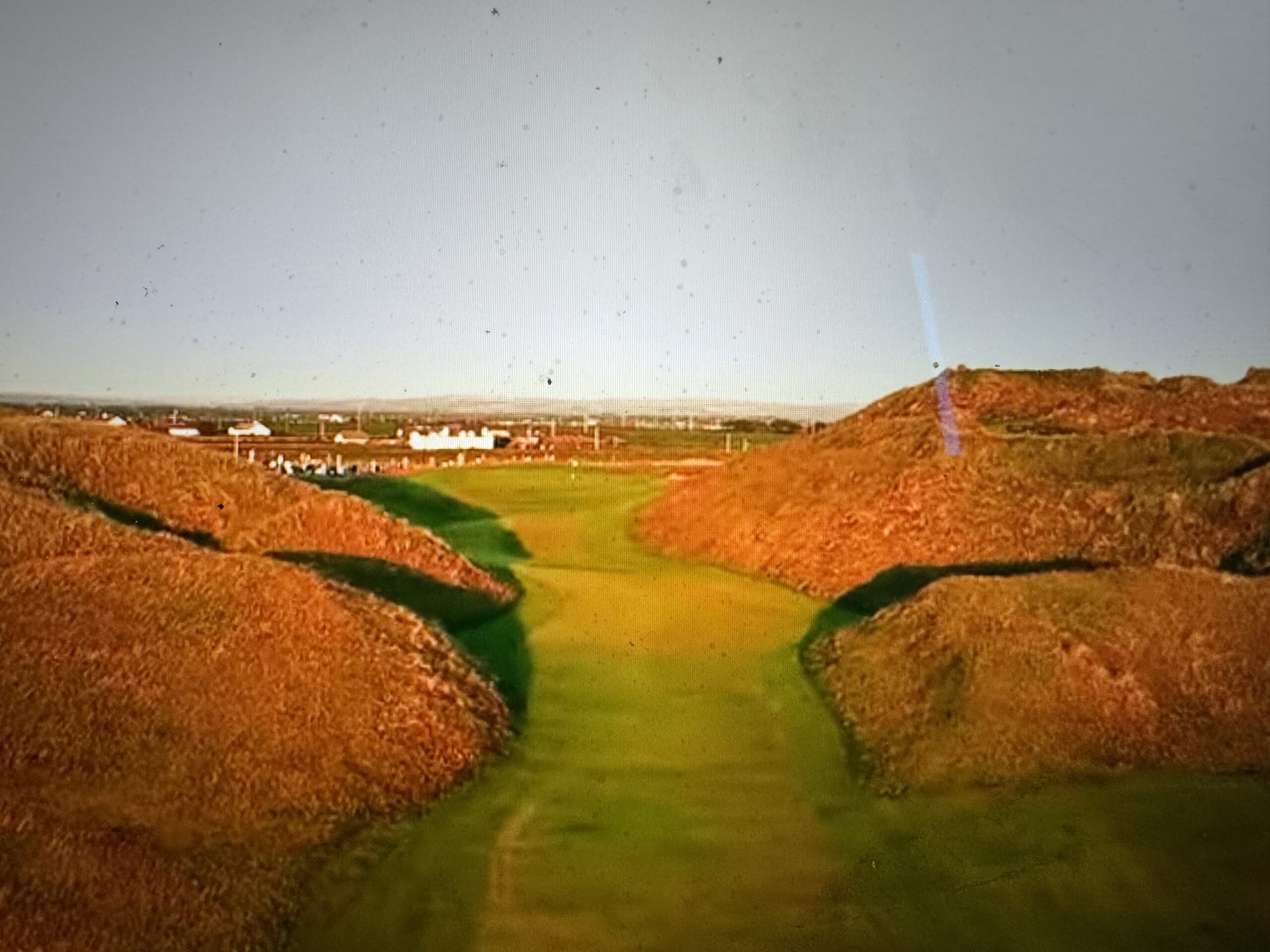
The 16th was my favorite hole on the course on this day. It’s a par five that stretches 469 yards from the green tees, and the architecture only gets more demanding the closer you get to the hole. This day I would play the hole from what seems to be a mere 386 yards but with a 35 mile per hour wind in your face, the hole clearly played closer to the regular 469 yards or more. I had played to the fairway but less than 200 yards off the tee so the next shot was to settle through the corridor without tasting mounds or gorse. The fairway is flanked the entire way by heavy mounding, thick rough, and brush pressing in from both sides, so there’s very little forgiveness for anything that drifts off line. The hole is like going to church as the corridor you’re asked to play is akin to the aisle navigating the pews on your way to the altar (in this case the green). The hole narrows well before you’d like it to. But it’s the approach that defines the hole. The green sits elevated above the fairway, tucked and guarded in a way that turns the second shot, and often the third, into something closer to a prayer offering. You are not attacking the green, you are praying as you climb towards especially with the 30 mile an hour wind in your face. There is a sense of reverence and consequence: get the angle right and the trajectory will be your friend and you might get a birdie opportunity. I navigated smartly and maybe luckily on this day and made par here.
Tom Watson’s Course
No conversation about Ballybunion is complete without Tom Watson. He first played the Old Course in 1981, in the buildup to his Open Championship win at Royal St George’s, and it changed the way he thought about the game. Watson has said, in various forms over the years, that Ballybunion tests every club in the bag and every shot a golfer owns — the low runner, the blind approach played on faith, the second-guessing that wind and dunes force on even the best players in the world.
The club has embraced him as thoroughly as he embraced it. Watson was consulted on changes to the Old Course in the years that followed his first visit, focusing his eye to a handful of holes as the club worked to preserve the character of the layout while keeping it relevant for modern play. Ballybunion made him an honorary member, and today a bronze statue of Watson stands on the grounds overlooking the course he helped put on the American golfing map.
I had a wonderful day here walking the course with all the views with my caddy. The wind never blew below 30 so even playing from the forward tees required significant focus and attention. You need to have a lot of different shots especially low ones to stay on top of the effort. Standing on those same tees in a wind that never dropped below thirty, I understood exactly what Watson meant. This isn’t a course that requires power. It yields to patience, peristence, and a willingness to play the ball on the ground when the instinct is to fly it at the flag.
My goal would be to get this body of mine in better shape to be able to come back and play this course at least 6100-6400 yards. I’m sure it would be another unforgettable experience.


0 Comments