
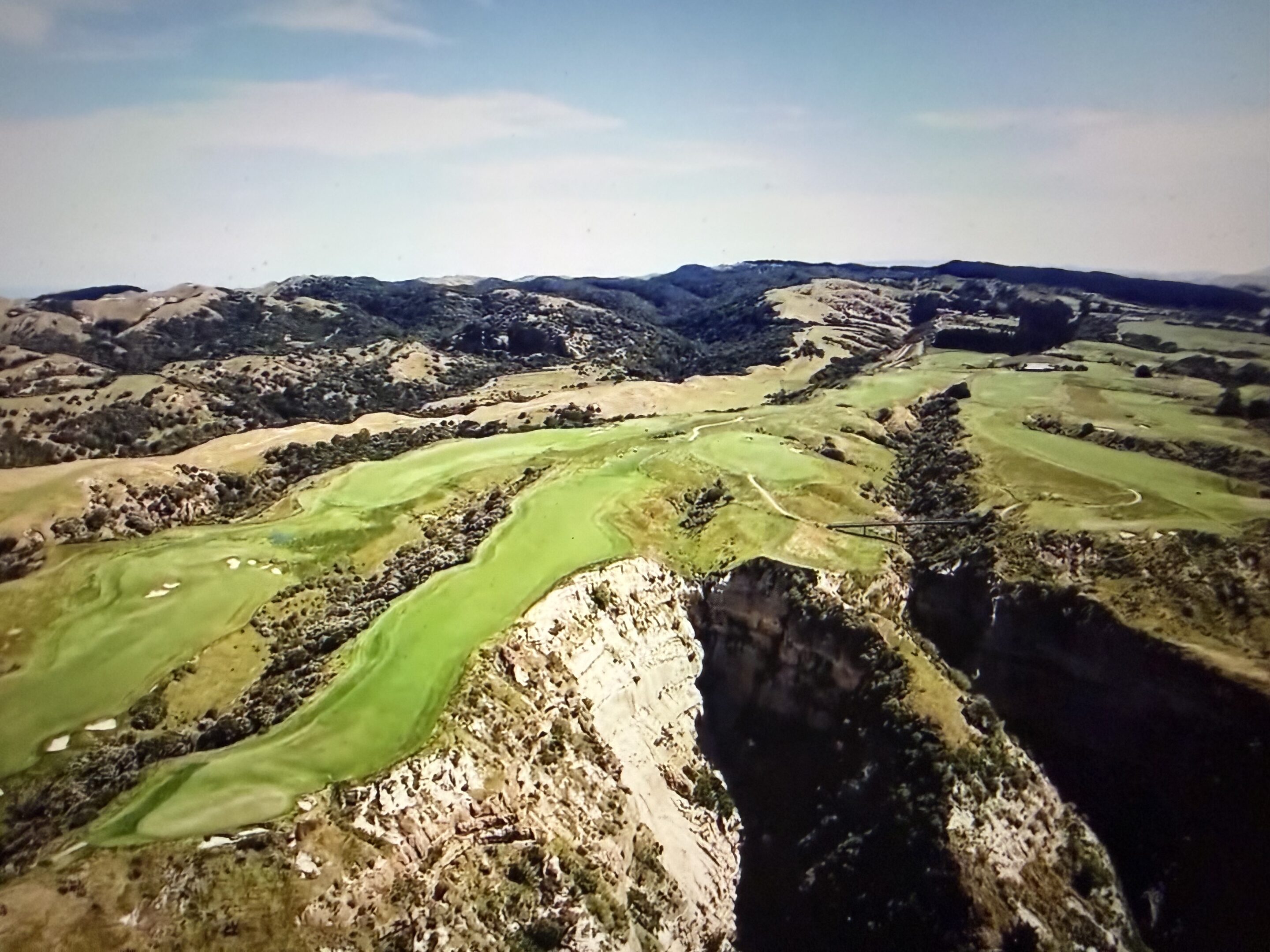
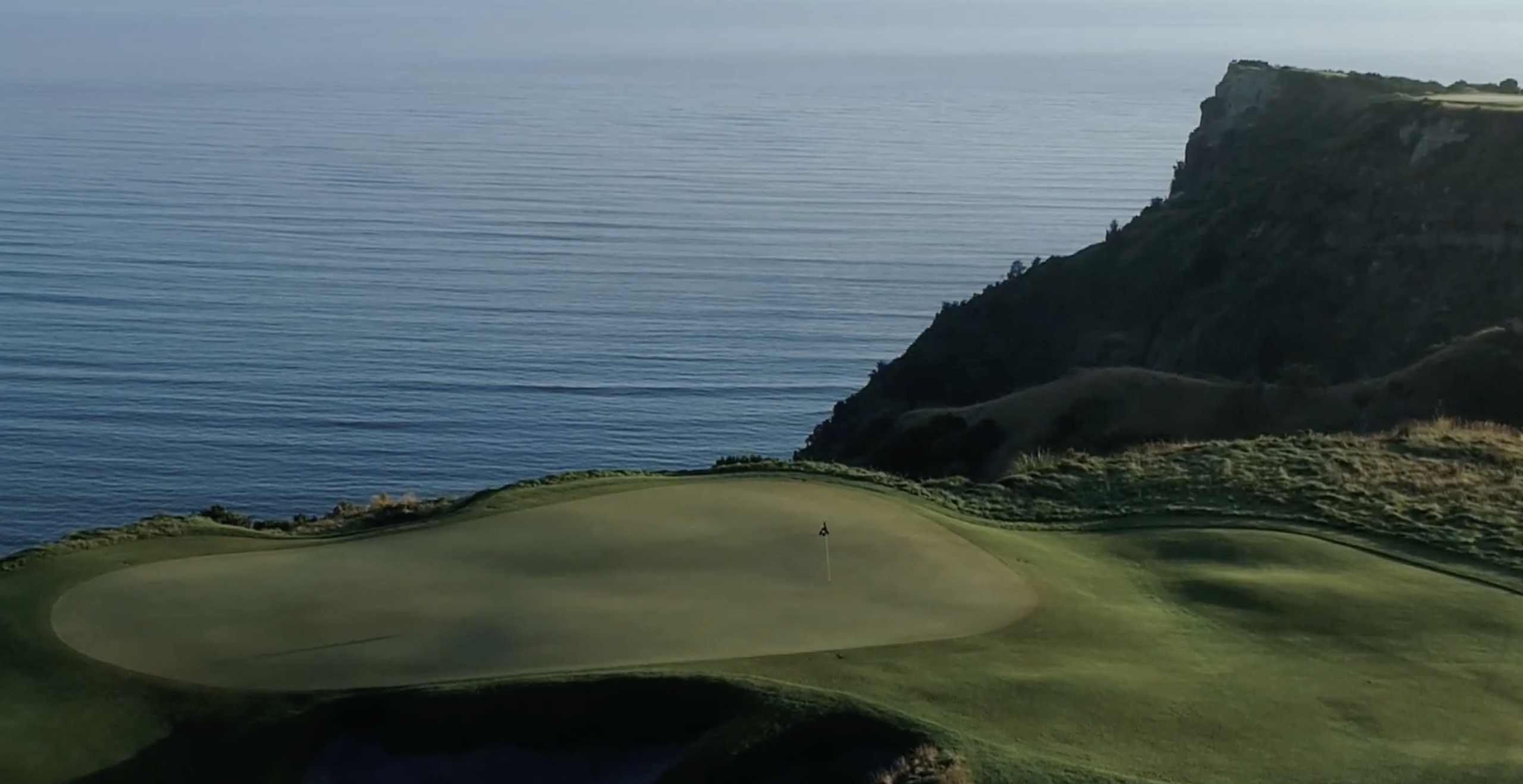

Left side of the 15th hole-500 ft. drop over the fence
Cape Kidnappers
Cape Kidnappers might be one of the most incredible golf venues ever designed. Cape Kidnappers, New Zealand is a coastal headland and a peninsula forming the southern boundary of Hawkes Bay jutting northeasterly into the magnificent Pacific Ocean. The land mass covers 6,000 acres of hills, cliffs, forest, and prairie land including one of the largest aviary of gannet birds. The property contains a working farm and ranch with a lot of sheep and cattle.
The golf course is the work of Tom Doak. It’s carefully and elegantly carved through the cliffs and terrains, appearing as if very little of the property was touched. A minimalist yet powerful design, on some holes, you’ll think you are playing golf somewhere other than planet Earth.
Doak’s work reminds you of Bandon Dunes – many holes make this track remarkable. It is not a golf course for the faint of heart, but neither does it feel like a continuous grind. The fairways are generous and must be experienced if you are going to score here. You are going to face wind, and it can be ferocious even in clear, sunny conditions. The par 3’s look very gettable but seem to be elusive as wind and pin positions toughen things up. One significant difference from Bandon is that the Oregon course is closer to pure links, and is more forgiving for the high handicapper, offering better playability throughout the round. You cannot walk Kidnappers as the distance between holes required by the design and the terrain is considerable—probably 8 miles or more compared to 6 in a typical course layout.
Kidnappers is not for the average or highhandicapper as 6 holes require significant carries over gorges that are either forest or jungle. Another 3 holes contain mounds that will test the accuracy of an iron shot to the green, and their challenges are exacerbated by the very windy conditions.
The greens are medium speed to my putter acumen probably in the 10-11 range on the Stimpmeter. When you finish the round, the first question is: how many balls did you lose, rather than what your score was. I was greeted with tremendous but respectful skepticism when I told them that I didn’t lose a ball. (I really didn’t-but I did move up a set of tees for certain holes)
The Course
15th Hole – Pirates Plank
I have to start my review of the course with the 588 yard, par 5, 15th hole named “Pirates Plank”, which plays at 650 yards from the back tee. The hole looks like a journey to nowhere, as flat as a Nebraska cornfield. The fairway is probably the widest on the course, but you better not miss it as the left side is bordered by a fence protecting you and any roaming creatures from falling hundreds of feet down into the Pacific. The right side is a significant drop into the jungle abyss. The wind will ultimately determine what happens on this hole as the approach shot to the green must be covered or else—going over the green is a trip into the Pacific Ocean. On a downwind day, I hit an approach shot to the green of about 170 yards, which was converted into a routine par. In another round against the wind, my fourth shot was a 9 iron of 110 yards, which luckily was close enough to make another par. The approach shots to this hole should be center to center/left as I noticed some very weird bounces can occur from second shots hit well but are right center. A shot hit to the right center of the fairway as a strong fade could find some serious undesirable scrub. If you manage to muscle an approach shot over the green, the ball will travel some 500 feet or about 10 seconds of hang time before it reaches the Pacific Ocean. The hole leaves you exhilarated as you’ve covered a lot of ground, and putt out facing the sea.
16th Hole—“Widow’s Walk”
The 15th and the 16th are my choices for the most rewarding holes of the course. Kidnappers’ strongest and longest par 5is followed by another 500 yard par 5. As you recover from surviving the 15th, you then face the 75 step climb up the hill to another cliff which is the 16th tee. This tee is carved from the top of another bluff overlooking the Pacific with spectacular views-I’m told that some couples have exchanged marriage vows on this tee although I would be hard pressed to understand how a bridal gown would manage the 75 steps.

The “walk” up to the 16th tee
The hole is 500 yards crossing another chasm, which is only about 150 yards looking down from this point. Finding the fairway should be well within reach of most players, but the challenge begins from the fairway. From the tee shot the fairway is uphill all the way to the green. The fairway is generously wide but the wind can play tricks and move a shot dangerously close to the right rough where the ball will die a natural death. Club selection especially against the wind is very tricky to a large, horizontally shaped green. Par on this hole is a very good score.
17th hole Gannets Perch
You have survived 15 and 16 either elated or exasperated and now face the very tough 17th hole, which I played at 420 yards. There really isn’t much trouble on this hole so the difficulty is presented by the behavior of the wind combined with the need to carry the greenside bunkers for the approach shot. It’s a weird feeling playing a hole that seems to be fairly straightforward but the wind has made it virtually impossible. I was flummoxed by the ferocity of the wind as I felt I would never get to the green.
18th hole “IPU”
I’m not sure what IPU means but I played the 18th as a par 5 as it is a 390-yard, par 4. The yardage of the hole is only critical depending on the wind. A wide fairway gives way to a second shot that will need to hang to the left side in order to avoid the steep bowl that will push any shot into the bowl. My first attempt was to play away from the steep drop into the bowl. What I thought was perfect jumped out of the left rough into the bowl where I still had a 50-yard pitch shot. My second attempt was simply play a 75 yard pitch shot directly at the pin at the top of the mound avoiding the bowl altogether. From this position, getting up and down for par is a much easier proposition.
9th hole “The Dip”
The 9th was my favorite mounded hole. I had forgotten playing the hole in prior years, in the pouring rain. I played a tee shot over the gorge from the forward tees. I “forgot” about the dip so the ball ended up at the top of the hill before the “dip” at about 150 yards, where I proceeded to airmail the green and made a horrid bogey on what is one of the easier holes on the course. Another try in the next round yielded the right result-a driver over the gorge in lovely sunshine carried the top and released to the bottom of the “dip” leaving an uphill chip to the green of only 45 yards. A 54-degree wedge stopped the ball 2 feet from the pin for one of the few birdies of the week. The 9th is a welcome respite following the difficult par 3, 8th and another more difficult mounded hole—the 7th.
7th Hole -14 Flags
The 7th hole is only 388 yards but it felt like 450 as the generous fairway is severely tilted from left to right so any tee shot isn’t likely to roll forward very much, leaving a daunting iron shot to the green over another significant dip on the right. A good tee shot that can hold the left side of the fairway will leave a medium iron to the large green, which is well bunkered. Kidnappers seems to alternate difficulty with ease as you meander through the cliffs, gorges and the bunkers. The course just seems to emit an air of fairness throughout the round. You will be rewarded for focus and staying in the fairways as well as greens that are pretty true and puttable.
1st Hole—Adequately Named—First
The first hole is your welcome to the idea that this is going to be a fair test but not an easy one. The hole is a 390 yard, par 4 with a generous fairway that slopes from left to right (similar to Number 7). If you are too far left, you will not get home in two, but be subject to your initial experience of a significant dip on the right. What is interesting about the First is that your introduction to the course is telling you that you had better pay attention to positioning your shots or else it will be a long day trying to recover. Bunkers are well positioned on the left side of the green to catch an iron shot whose distance is misjudged.
6th Hole Gulley
The 6th hole is the most intimidating hole on the course as a par 3 of 225 yards from the back tee and 190 yards from the forward tee. The teebox is on the top of a cliff and reminded me somewhat of No. 3 at Mauna Kea in Hawaii. The difference between the two holes is the wind-the wind at Kidnappers will blow hard in all conditions from right to left (towards the ocean). The green is one of the largest on the course reminding me of one of the Old MacDonald holes at Bandon where four putting is a potential possibility. I was completely spooked and would have been pleased just to carry the gorge and all the bunkers so I aimed my tee shot with a three wood to the right of the hole as far as I dared. The ball flew and I knelt in prayer as it carried the right bunker and ended up in the rough pin high. I proceeded to produce a minor miracle 60-degree wedge to a foot for par. I did experience other adventures of required bunker shots on this hole in other rounds but the quality and uniformity of the sand was very good.
I’ve now played nine rounds at Cape Kidnappers and I continue to learn and experience the wonderment of the views from the cliffs, the terrain and the general playability of this beautiful piece of property. For true golf aficionados, players who welcome real challenges and appreciate both spectacular scenery and masterful design, make a plan and go.
I will close this with the words of Tom Doak to summarize, “You will never play golf somewhere like this again.”


0 Comments