
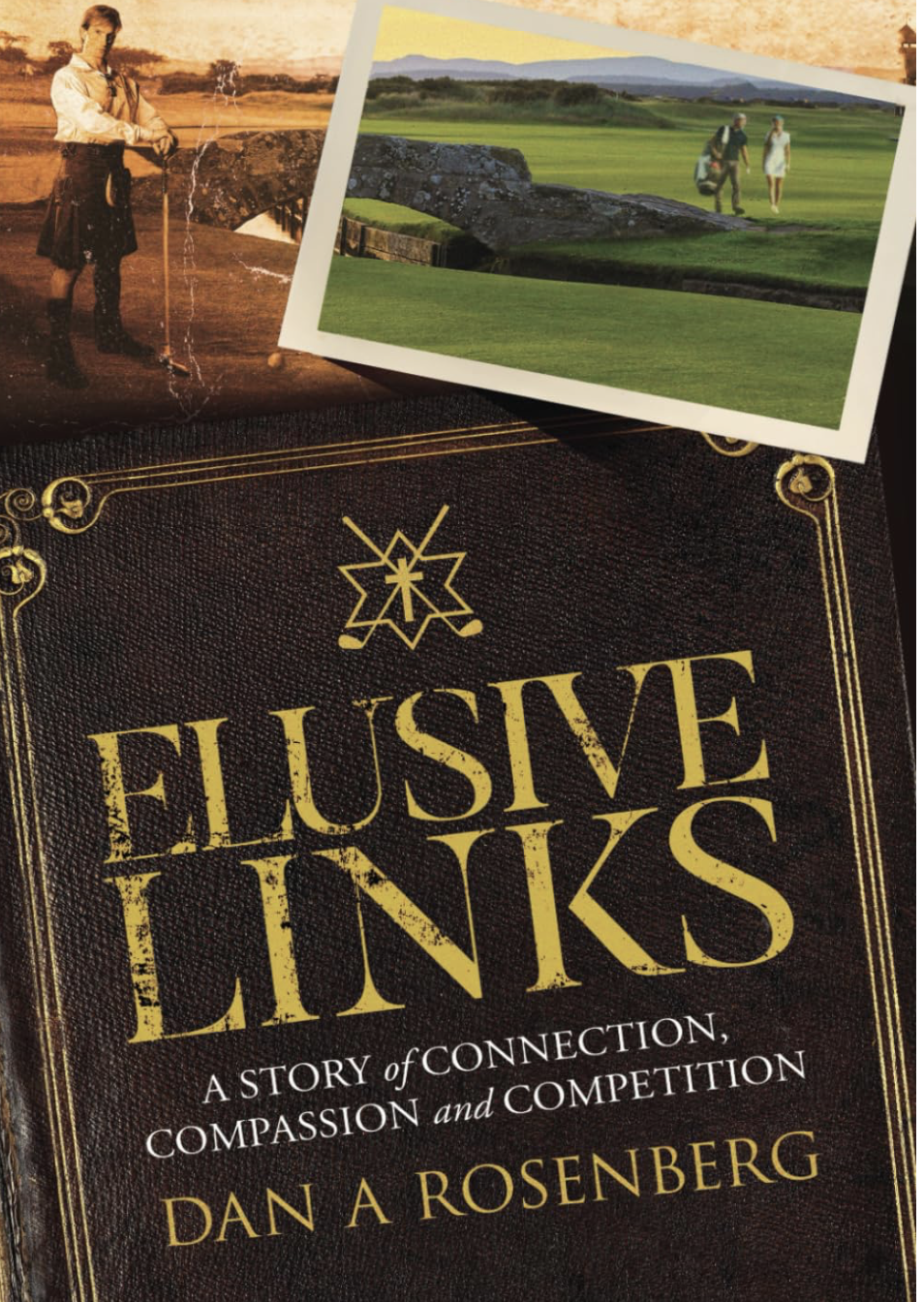
Elusive Links by Dan Rosenberg is an epic tale of fictional history dealing with a wide variety of plots and themes including European history, genealogy, romance and the teachings of Maimonides across multiple story lines separated by five centuries. When you open the book and review The Table of Contents, it looks like you’re about to encounter a daunting and perhaps boring task of trying to figure out what the book is really going to cover.
What follows are two fascinating journeys separated by 500 years of philosophy, history, ethical values, and relationships with a golf thread running through it. Rosenberg, without stating it directly, uses golf as the medium that connects the dots. It is not a golf book.
Character development is rich and thorough as Rosenberg explores tenets of religion, inter-faith marriage, ethical values, class ambitions, compassion and connectivity.
The book achieves communicating through a wonderful story of a hierarchy of values:
–Maimonides principles are very important
–Connections and relationships are established in a historical fictional context
–Essence of golf is defined and transmitted in the context of the “links.”
–Philanthropy and charity, family genealogy are covered through a golf thread
–History of golf is intriguing and a kind of “bonus” to the story
Maimonides was a Jewish philosopher, physician, scholar and religious thinker, born in 1135, who lived in Spain, North Africa, and Egypt. Maimonides believed that the highest form of charity and moral behavior was essentially helping others become self-sufficient without individual recognition. This moral dimension is one of the significant threads that binds the various themes throughout the book. Ben Solomon, a Jewish exile from Spain, eventually makes it to Scotland escaping the Spanish Inquisition, and becomes affiliated with the early development of the game of golf under the protection of King James IV. The historical sections explore persecution, displacement, survival of a Jewish experience throughout Europe in the 15th and 16th centuries. The historical venues are well researched.
It’s a dizzying journey as the book scans over 500 years from the development of golf to the final Master’s championship where Tommy Torres, an unsung minority player competes against seasoned professional Rusty Stephens. Moving back and forth between history and the current world is a tricky task but Rosenberg is able to hold the reader’s attention throughout these rapid transitions.
Torres is invited by the Augusta National Club without qualification as a worthy competitor solely for purposes of inclusiveness. Rosenberg is using a Torres as a literary “plant” to make the point that it is a worthy gesture of inclusiveness. We all know that Augusta National would never invite a player to compete in The Masters without significant qualification. Rosenberg is using Augusta National as an application of a Maimonides principle—providing opportunity with no expectation of a return.
The relationship and courtship saga of Rusty Stephens and Sandra Cole is an unusual pairing of Christianity and Jewish theology. Cole provides one of the key connections to the historical fiction through an effort to investigate the genealogy of Stephens’ caddy. While the couple formulate a robust romantic relationship, there is another dimension of transformative linking between them. Stephens is a successful professional golfer and the dimension of how he pursues an excellent career in the world of professional golf is well documented. Cole is not necessarily attracted to golf as a profession but is attracted to Rusty’s approach to the game and combines the feeling with her drive to find the truth of her heritage in a way that takes their relationship to a different intellectual plane of not only romance but sustained mutual trust and respect.
The book says a lot about the game of golf, in the way Rosenberg’s characters comport themselves. Their behaviors are not well founded in today’s societal values. Golf is fundamentally an individual sport. You keep your own score. In competition, you report your score to your competitor as well and vice versa. You play under golf’s biblical foundation of The Rules of Golf promulgated by the United States Golf Association and The Royal and Ancient Golf Society. You make your own decisions and are solely accountable for the results of those decisions. You suffer the consequences of your own mistakes and are individually morally responsible for adherence and compliance with the Rules of Golf. You default to the worst possible outcome of your own decision making and compliance with those rules.
Golf creates the environment in which connections between people matter enormously. The principles of Maimonides determine how those connections are nurtured over time. All of the characters demonstrated these principles at some point in the story. This book travels a long way and is well worth the journey.
Elusive Links are actually Established Connections


0 Comments