
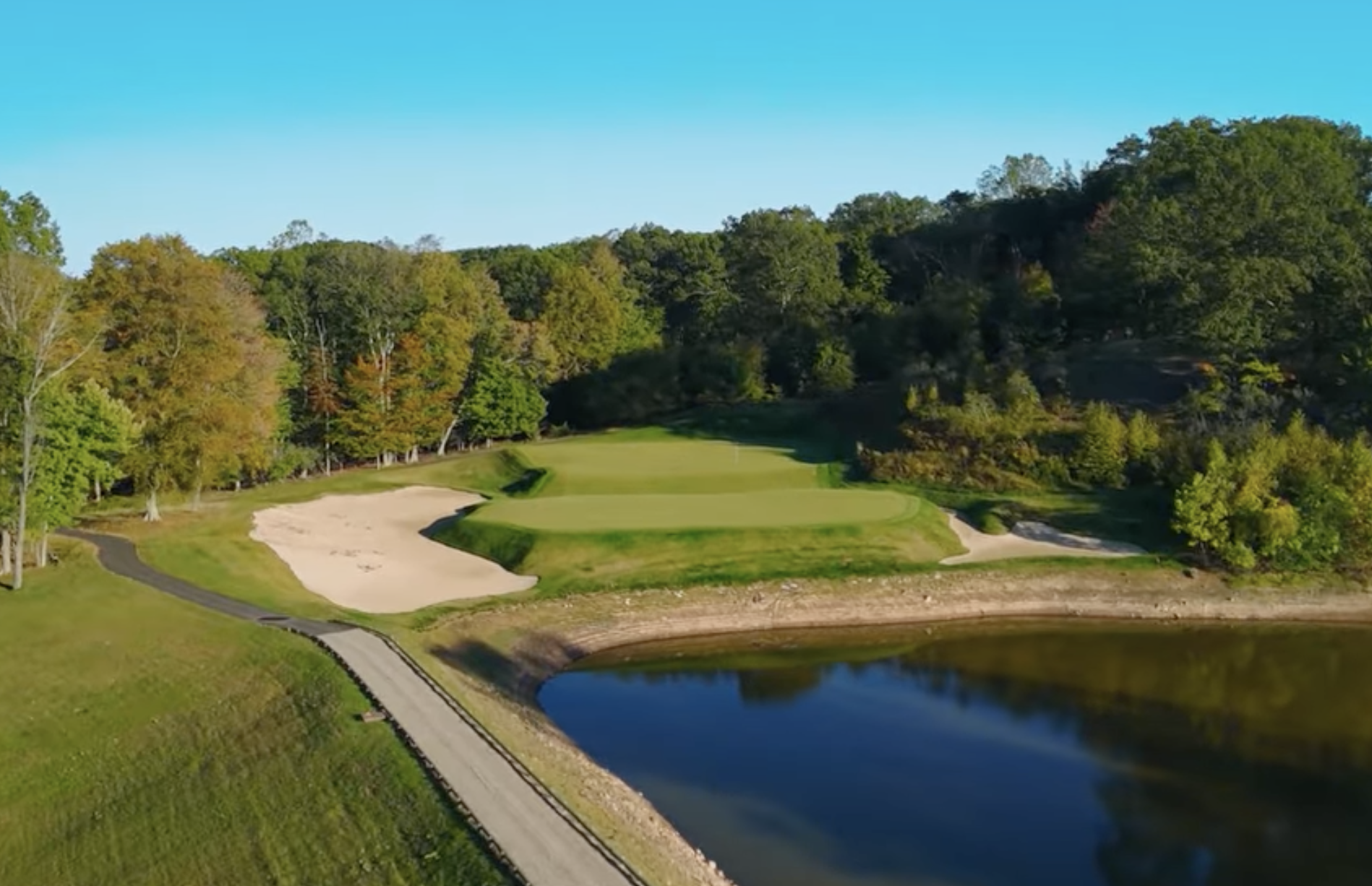
Yale CC–An Exciting Renovation becomes an Embarrassment
Seth Raynor’s masterpiece got a $30 million restoration. Instead of the transformation of one of the best designed golf course in the United States, the result became a nightmare for Gil Hanse.
By now most golfers have seen the photos: thin fairways, patchy greens and weeds at a course that reopened in April 2026 after a two-year, $30 million restoration by Gil Hanse and Jim Wagner.
Yale hired the leading designer in the country and perhaps thought that money would transform Yale in the potential afforded by its unique Macdonald/Raynor design. Gil Hanse should have recognized Yale’s history of benign neglect of its gem and insisted on taking on the maintenance of the redesign by selecting the contractor to perform that work.
Golf has never been high on the list in Yale athletics. Even in its better years, Yale had the feel of a public golf course: burned-out fairways in summer, uneven patches through the landing areas, and greens that never matched the quality of the architecture. When the pandemic hit, Yale let the course go so badly that the famous Biarritz green on the 9th was overrun with weeds and lost its shape. That neglect is the main reason a restoration of this scale was needed in the first place.
Yale recognized the opportunity to transform the course into potentially a top 25 course in the country with a significant upgrade of its fairways and greens while maintaining the design concepts that Macdonald and Raynor implemented many years ago. Yale spent $30 million to undo the consequences of its own neglect, then handed the finished product back to the same athletic department, without the staff or the priority to look after it. Within about five months, the course had visibly deteriorated.
The Reopening
The renovation was significant and Hanse was able to take the time he needed as the course was closed for over 2 years.
Yet when it was handed back, Yale reopened to public play at $350 a round, allowed heavy cart traffic on immature turf, and ran maintenance with a crew sized for an ordinary course rather than one with greens averaging 14,000 square feet. Hanse himself told Golf Digest that he didn’t think anyone involved could be objectively happy with how the course was being maintained. Alarm bells should have been ringing in the hallowed halls of the ivy kingdom but golf at Yale doesn’t hit the priority list. I might say the same for Stanford University as well but at least their golf course is well maintained.
An architect of Hanse’s stature, taking on a centennial restoration of a Raynor masterpiece, should have done more diligence on whether the client could sustain the result. That means insisting on commitments before construction began: a superintendent with restoration experience, a properly sized crew, a realistic budget, and limits on cart traffic during grow-in. (or no carts period…courses such as Pebble and Spyglass generally don’t allow carts on fairways for public play.)
Instead, the restoration made the maintenance problem bigger. Nearly 200,000 square feet of putting surface was recaptured. More than 200 yards were added to the championship tees, taking the course past 7,050 yards. Every expanded green and every new tee is more ground for an already stretched crew to look after.
The result is where Yale finds itself today. Five months after a celebrated reopening, a course that should have been the showpiece of its centennial year is being reseeded and resodded, its maintenance has been taken away from athletics, and the architect who restored it has been called back to help salvage the work. For a $30 million project, it is an embarrassing place to be.
Connecticut Weather is no Excuse
Growing conditions in Connecticut are genuinely difficult. Summers are hot and humid, winters are hard, and this summer was a tough one across the Northeast. But private clubs in the same state handle it every year. The Patterson Club and Brooklawn Country Club in Fairfield both present wonderful layouts in excellent condition, because their members and boards have made course care a priority and funded it accordingly. Yale, despite a benchmark design, and a significant investment failed to execute. What it lacked was the commitment to excellence which in golf course maintenance is hard to achieve and requires considerable skill to optimize the design created by the architect.
The Remediation
Yale is now in diving catch mode with its credibility in tatters. The remediation has Hanse back to close the loop on what should have been done in the first place. Course maintenance has moved from the athletic department to University Operations. Hanse’s firm has been brought back in an advisory role, reseeding and sodding are under way, and cart traffic is to be halted by mid-October. I would stop cart traffic on the fairways altogether for at least the next year. Yale’s credibility at course maintenance is a long-standing problem, and it will be interesting to see if it can be overcome.
It’s not certain where the reputation of this course sits in the hierarchy of Yale’s reputation for athletics, and it sure doesn’t seem that the university cares very much about this golf course. We passed on playing here on this trip so as not to be disappointed and to remember some good rounds played there before the restoration.
The Ninth Hole
Despite the reopening woes of Yale CC, the ninth hole deserves a review from the restoration and the design of the hole.
The Restoration
The 9th was one of eight greens that Hanse’s team found had been altered over the years. None had ever been rebuilt from scratch, so they could dig down through the layers, find the material Raynor used to finish the surface in 1925, and trace that original layer across the green. They scanned the restored contours with 3D mapping and checked that the slopes and pin positions would still work at modern green speeds.
Roughly 1,500 trees were approved for removal across the property, and the clearing has reopened views of the 9th green that had been closed in for years.
The Biarritz/ Redan Concepts
The design concepts are Macdonald-Raynor par-3 templates, both tend to be long, and both reward a player who thinks before pulling a club. The Redan is a test of direction and the ground game. The green is set at an angle, running away from the golfer from front-right to back-left, with a deep bunker guarding the front left. The classic play is a shot aimed right of the flag that lands short and feeds along the slope toward the hole. The original, the 15th at North Berwick, is still the best explanation of the Redan idea.
The Biarritz is a test of distance. The green sits square to the tee, but it’s enormously deep and is cut in two by a swale running side to side. Direction matters far less than finishing on the correct side of that trench. Hit the right number and you have a putt; hit the wrong one and you have a huge problem-potentially a four putt problem.
| Redan | Biarritz | |
| Green orientation | Angled away from the tee, front-right to back-left | Square to the tee, very deep front to back |
| Defining feature | Green tilts away; deep bunker guards the front-left | Deep swale cutting across the middle of the green |
| Question it asks | Direction: where to land it so the slope feeds it in | Distance: which side of the swale to finish on |
| Preferred shot | Running shot played right that kicks left toward the hole | A precise carry number, plus a read on how far it will release |
| The original | 15th at North Berwick West Links | The Chasm hole at Biarritz, France (long gone) |
The Hole
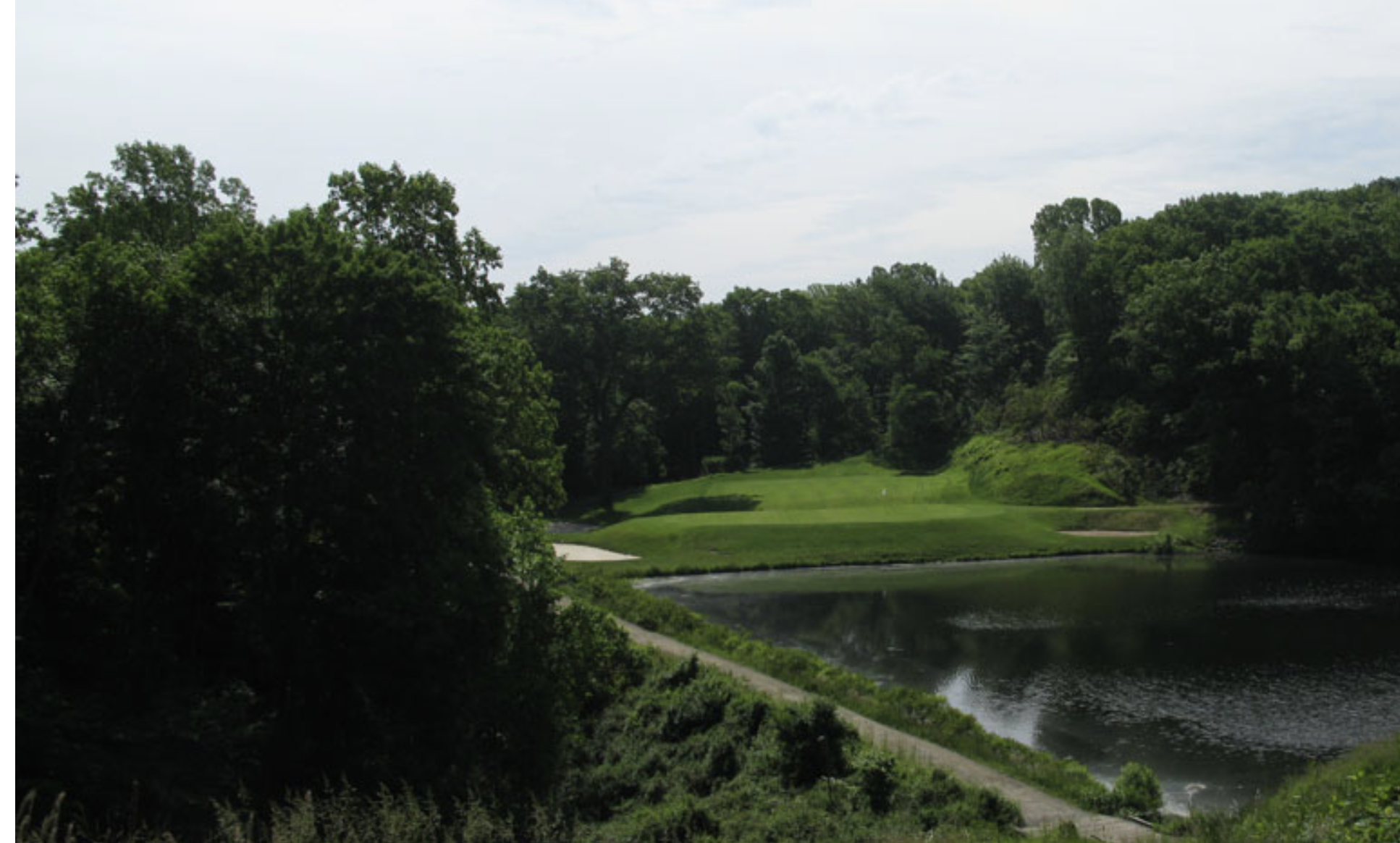
The 9th plays slightly downhill from an elevated tee across a pond that runs the entire way to the front of the green. On the card it has historically been 213 yards from the back, with forward tees at 196, 166 and 146, but the number that matters is the hole location. Depending on where the flag sits on a green that deep, it can play anywhere from about 170 to 235 yards. The carry over the water from the back tee is somewhere around 165 to 175 yards.
The green itself is the show. It was already about 65 yards deep before the restoration. Hanse and Wagner recaptured enough surface that it now covers roughly 22,000 square feet, by far the largest green on a course whose greens average about 14,000. The swale running across the middle is generally regarded as the deepest of any Biarritz Macdonald or Raynor built; estimates range from about 3 to 5 feet. Bunkers flank both sides of the green, and the back section slopes hard from right to left, which makes a back-right flag one of the hardest pins on the course to get close to.
How It Plays
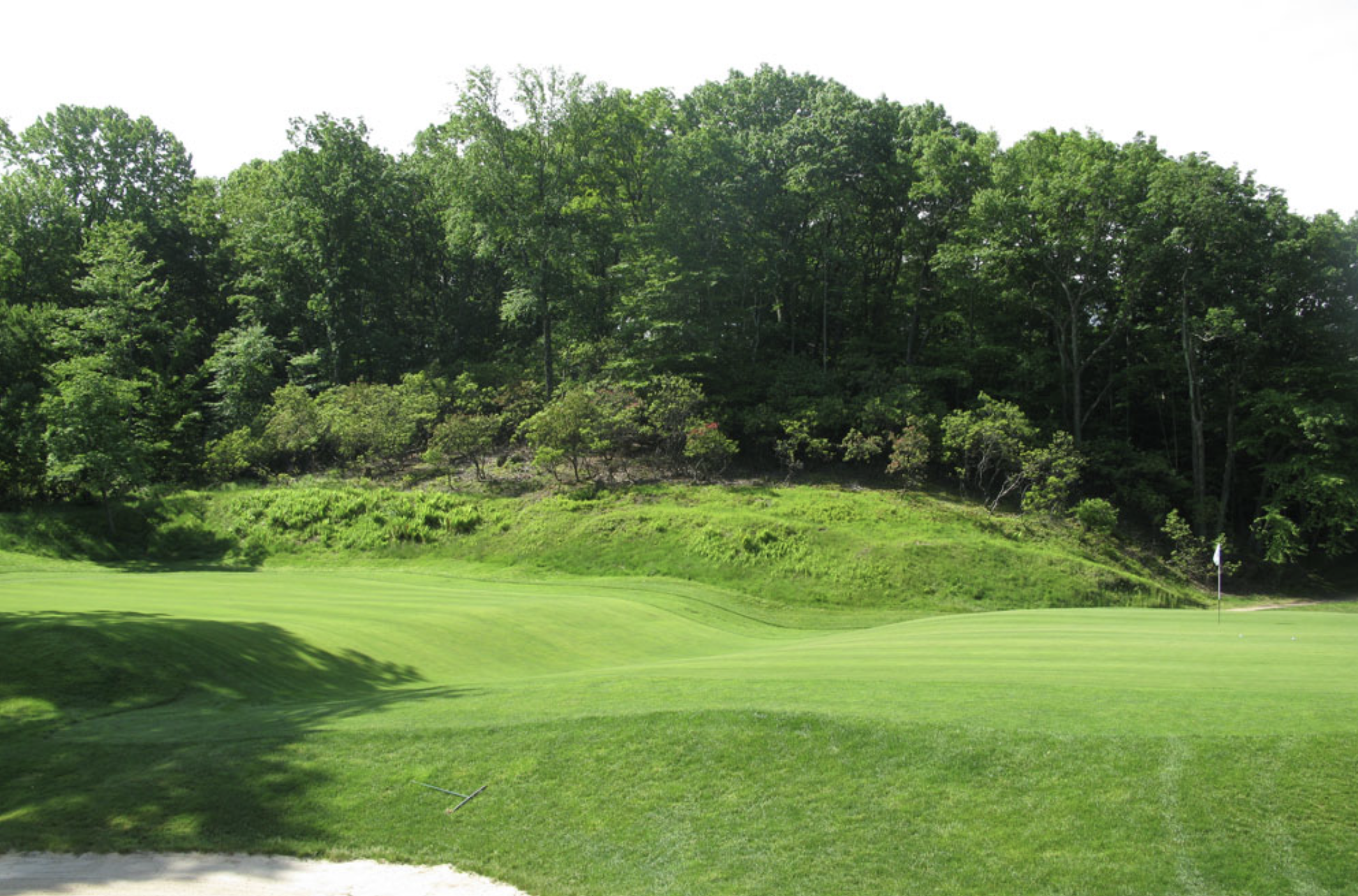
swale on the new green
Everything on this hole starts with the pin sheet.
- Front pin. This is the one that is most difficult to get close to the pin. The water is right there short, and you need to carry it and stop the ball before it trickles into the swale. Front pins are arguably more exacting than back pins.
- Back pin. The full 230-plus yards. The tee shot has to clear the pond with enough left over to run up and out of the swale onto the back shelf. Anything that comes up short of the far slope rolls back into the trench.
- Middle of the swale. Rare, and mostly a novelty. It turns the hole into a bowl and takes away much of the strategy.
The miss hierarchy is clear. The best result is anywhere on the correct side of the swale. Next best is the swale itself: an unpleasant putt, but par is still possible. The bunkers are worse than they look, because a bunker shot hit even slightly too firm can run into the swale and set up a three-putt or four-putt. The water short is the only truly fatal miss. I still believe putting out of a Biarritz swale is harder than putting out of the Valley of Sin at St Andrews but probably an equal challenge to the bunker shot at the 17th Road Hole at St. Andrews.
My Take
Yale potentially has one of the greatest golf courses in America, but it has not committed to making this happen. It will be hard to overcome the bad publicity and reputation of this redo, and it will undoubtedly knock Hanse off his perch. Hopefully, the renovation of Spanish Bay in Pebble Beach will be positive for Hanse, and I predict it will, as the Pebble Beach Company has high commercial aspirations for Spanish Bay as an exciting alternative to Pebble Beach Golf Links and Spyglass Hill. The green fees at Yale are not an issue if the public can assure that Yale will take care of its gem and not treat it as required university overhead.


0 Comments